Boughstead Tree Care
A residential tree-care site built around the choice between care and removal.
Concept project · Fictional business demonstration Boughstead is a fictional company. AI-generated photographs illustrate the concept, not customer work. No reviews, ratings, credentials, pricing or trading history are invented. Calls are demo notices and forms send and store nothing.
A 17-route residential tree-care concept with a twelve-band homepage, eight service pages, a demonstration assessment request and matching WordPress output verified in an isolated runtime.
Fictional concept, with visible disclosure and noindex in HTML, HTTP headers and robots.txt.
- Type
- 17-route residential tree-care concept
- Stack
- Eleventy 3, self-hosted fonts, classic WordPress parity
- Hosting
- Cloudflare Pages; WordPress validated locally
- Status
- Live concept demo, noindex
- Live demo
- boughstead-tree-care.pages.dev
Brief
Care or removal is a decision, not a default
A homeowner with a large tree near the house, driveway or fence often does not know whether it needs pruning, removal or an assessment. The design objective was to help them tell those apart before asking for anything.
The site keeps three homeowner needs in view:
- Recognise the concern and find the service that starts that conversation.
- Understand what an assessment has to consider: access, nearby structures, cleanup and the stump.
- Make one clear request, with calling available but secondary.
All business details are fictional. The case study evaluates the website, not an operating tree-care company.
Design decisions
The property first, the company second
Bark, parchment and moss carry large residential photographs. Each section uses a different arrangement instead of a repeated card grid.
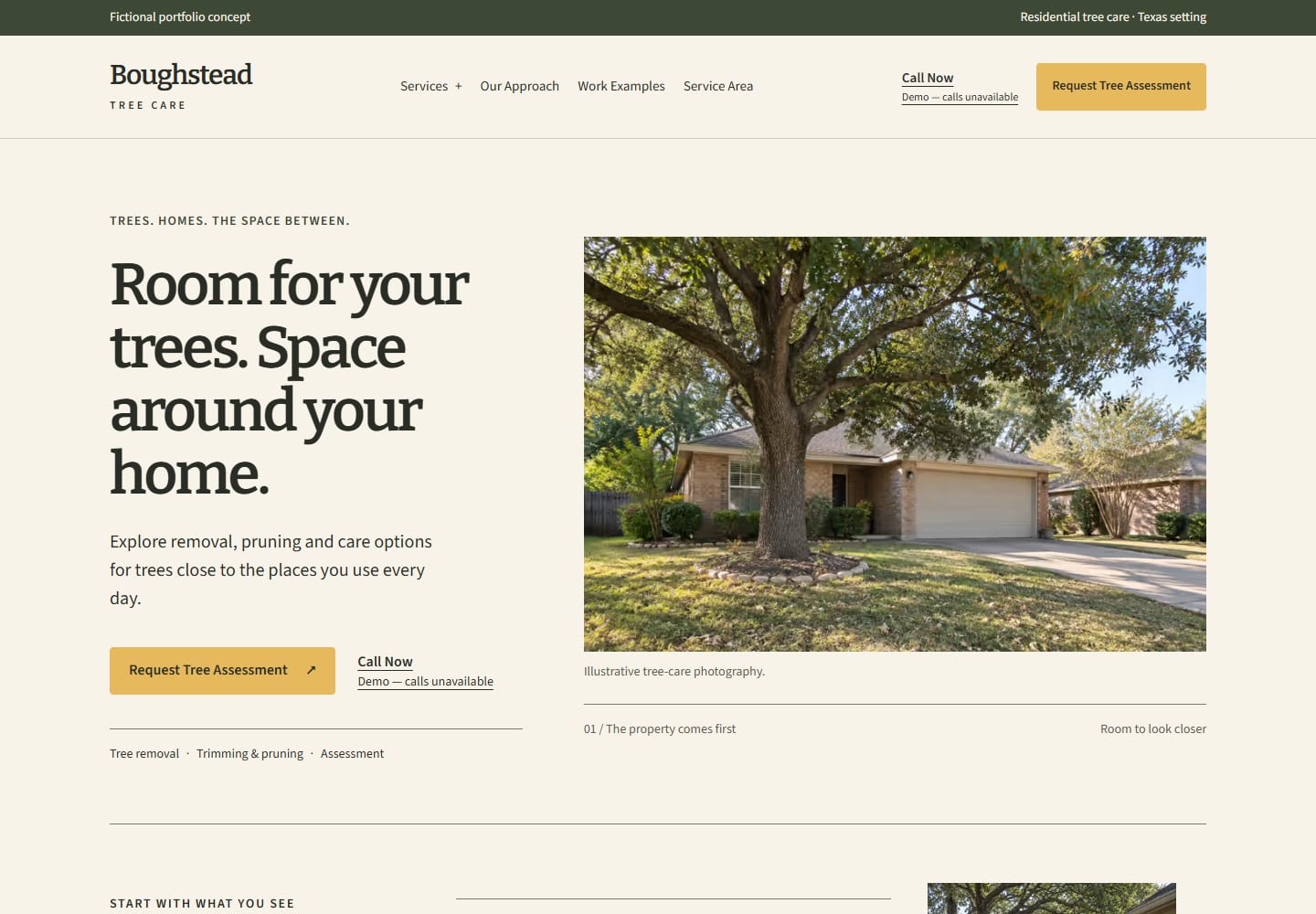
A headline about the space around the tree
The opening pairs a property photograph with an assessment request and a clearly labelled demo call. At phone widths, both actions stay in a fixed bar, keyboard-tested so it does not hide focused links.
Two paths with different questions
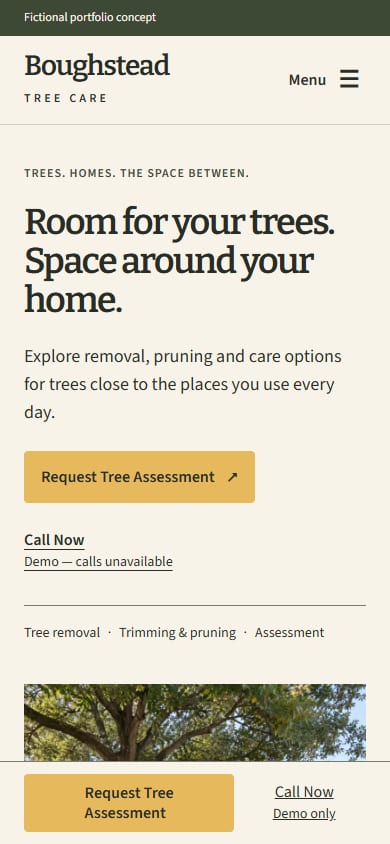
Care gets the larger canopy photograph and removal the smaller, practical one. Each leads to its own service page, and captions say that no diagnosis is implied.
Scope shown, not promised
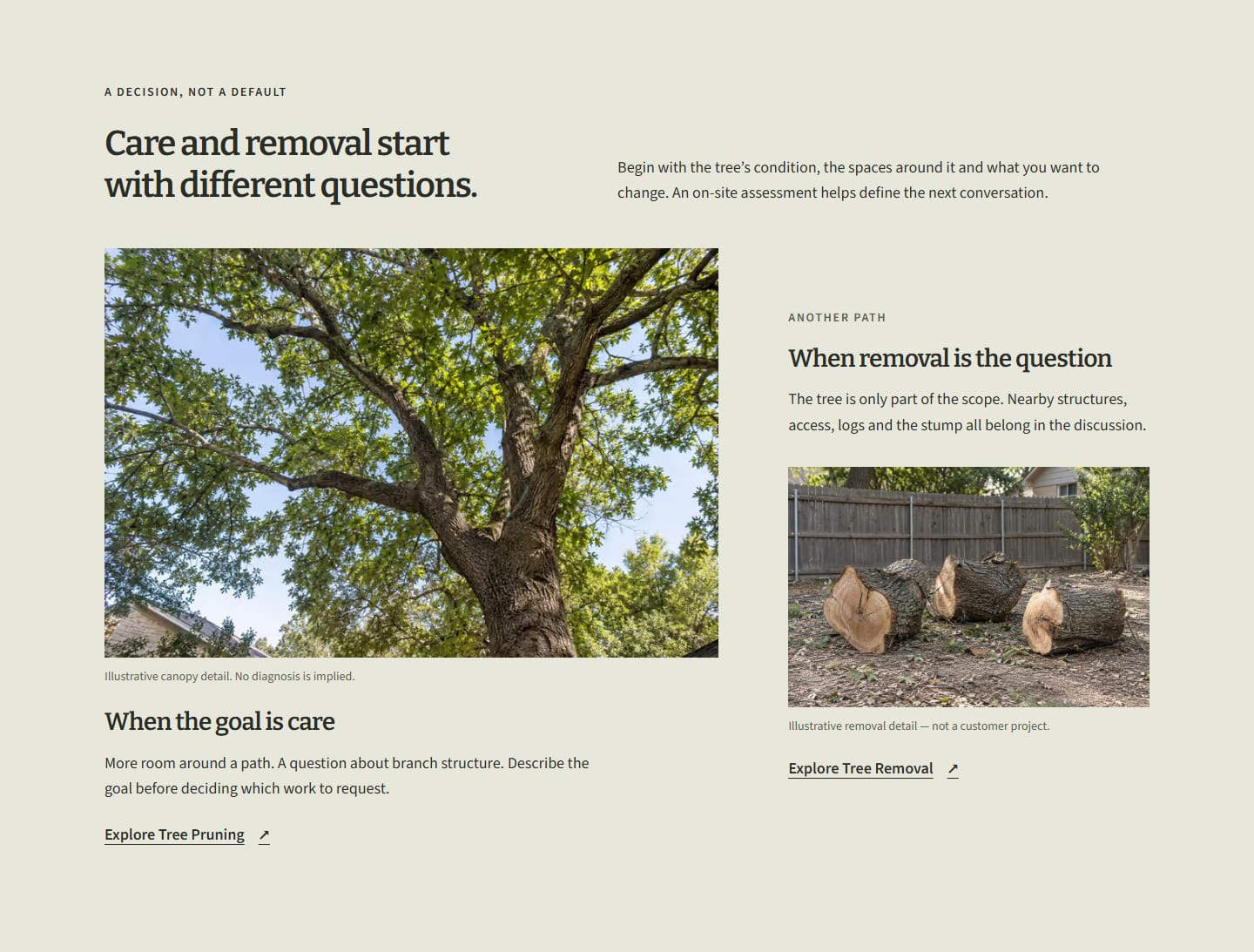
A labelled before-and-after pair shows that stump grinding and a finished yard are separate pieces of work. It is marked as an illustrative sequence, not a customer project or a promised result.
An honest request form
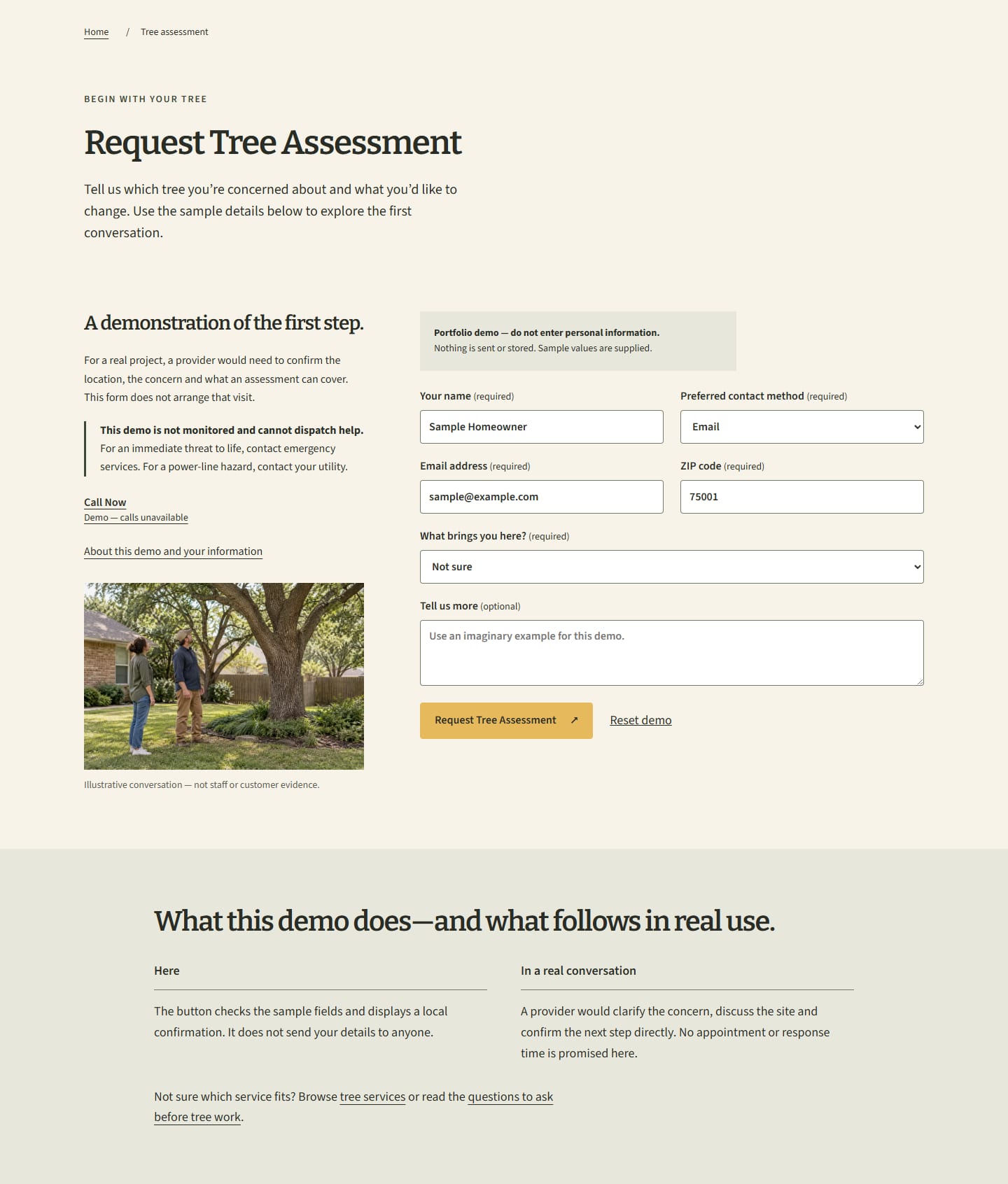
The assessment page puts the fields first on mobile. It says plainly that nothing is sent and that the demo cannot dispatch help, and it points to emergency services and the utility for immediate hazards.
Method
Reference-led, implemented from scratch
- The references
- Two public tree-service websites were analysed as design references. They are not endorsements, and no affiliation is claimed or implied.
- What they informed
- Hierarchy only: identify tree-service intent before company history, put a clear next action in the first viewport, keep phone access without a popup, and help visitors choose care, removal or assessment before showing equipment.
- How it was kept separate
- The analysis was distilled to structural principles in a separate step. Design and code worked from that distillation, not from the reference pages.
- What is original
- Name and wordmark, typography, colour system, every word of copy, the photography direction and all 13 photo masters, the route structure, the components and every line of markup, CSS, JavaScript and PHP.
- What was not taken
- No reference text, photograph, logo, icon, colour value, CSS or markup. Claims seen on the references, such as reviews and credentials, were deliberately left out.
Implementation
One static build, one WordPress theme, both checked
- Routes
- Home, a services directory, eight service pages, six supporting pages and a custom 404: 17 routes.
- Photography
- 13 AI-generated masters and 117 responsive AVIF, WebP and JPEG files, each captioned as illustrative. File hashes are checked on every build.
- Forms and calls
- Demonstration only. Browser checks observed no requests, storage or cookies. Call actions open a notice instead of dialling.
- WordPress
- A classic theme with editable copy fields. All 17 rendered routes matched the static site at two widths. It was verified in a local runtime and is not deployed as WordPress.
Measured results
Measured on the live concept
Lighthouse 13.4.1; one mobile and one desktop lab run on 19 Sep 2026. Not field data or a multi-run median.
| Page / device | Performance | Accessibility | LCP | CLS | Transfer |
|---|---|---|---|---|---|
| Home, mobile | 99 | 100 | 1.98 s | 0 | 515 KB |
| Home, desktop | 100 | 100 | 0.50 s | 0 | 524 KB |
Verified
- 17 live routes and 126 files byte-identical to the release build.
- 32 live axe checks, zero reported violations.
- Tree Removal, Emergency Tree Service and Tree Assessment scored 100 for performance on mobile and desktop.
- Custom missing-route HTTP 404, strict CSP and noindex headers.
Not claimed
- Customer leads, bookings or conversion improvement.
- Field Core Web Vitals or real-user INP.
- A production WordPress hosting deployment.
- Search ranking. The concept is noindex by design, which is why Lighthouse SEO is not shown.
Credits
Credits and disclosure
- Concept project. Boughstead Tree Care is a fictional business demonstration; there was no client and no real company.
- Design, copy, photography direction, build, QA and deployment: Tarkenil Studio.
- Reference-led: two public tree-service websites informed hierarchy only. No copy, photograph, icon, colour, logo or markup was taken from them, and no affiliation is claimed or implied.
- Typefaces: Bitter and Source Sans 3, both under the SIL Open Font License 1.1, self-hosted.
- Photography is AI-generated and illustrative. It shows no customer property, staff or completed work.